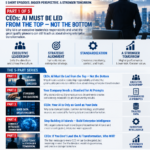
CEOs Must Lead the AI Transformation
C-Suite AI Leadership Series — Part 5 of 5
Artificial intelligence is rapidly changing how organizations manage information, evaluate risk, improve operations, and make critical business decisions. Companies can delegate many parts of an AI implementation—but they cannot delegate executive leadership.
Programming can be assigned to developers. Technology selection can be managed by IT. Data preparation can be performed by technical teams. Individual AI projects can be led by department managers.
But determining how artificial intelligence will influence the organization’s future is ultimately the responsibility of the CEO and C-suite.
In the final installment of Harrington Group International’s five-part C-Suite AI Leadership Series, Rick Harrington, Jr., CEO of Harrington Group International, examines why successful enterprise AI transformation must be directed from the top.
Artificial Intelligence Is a Leadership Issue
AI is more than another software purchase or technology upgrade. It can influence how an organization:
- Accesses institutional knowledge
- Analyzes operational and quality data
- Recognizes patterns and emerging risks
- Investigates nonconformances and recurring problems
- Evaluates possible corrective actions
- Predicts potential outcomes
- Supports management decisions
- Protects proprietary information
When technology begins influencing decisions across quality, manufacturing, compliance, finance, supply chains, and customer service, it becomes a corporate governance issue.
Without executive direction, individual departments may adopt disconnected AI tools, inconsistent prompts, conflicting data definitions, and different standards for verifying AI-generated information. This fragmentation can create unnecessary risk while preventing the organization from realizing the full value of enterprise AI.
What the C-Suite Must Establish
Executive leadership does not require CEOs to become programmers or data scientists. It requires them to establish the direction, standards, accountability, and resources necessary for responsible AI adoption.
A comprehensive enterprise AI strategy should address:
Trusted Data
AI output is only as dependable as the information supporting it. Organizations need clear standards for data quality, ownership, classification, lineage, retention, security, and authorized use.
Standardized and Controlled Prompts
Prompts used for recurring or high-impact business processes should be treated as controlled procedures. They should be tested, approved, versioned, monitored, and updated as business requirements change.
Verification and Human Oversight
AI-generated recommendations should not automatically become final business or quality decisions. Qualified personnel must remain responsible for reviewing evidence, evaluating context, and approving consequential actions.
Information Access and Security
Not every employee or AI application should have unrestricted access to every corporate record. Role-based permissions and retrieval controls are essential for protecting confidential, proprietary, regulated, and export-controlled information.
Accountability
Organizations must define who owns each AI-supported process, who validates its performance, who approves changes, and who is accountable when its output affects an operational or management decision.
Measurable Business Value
AI initiatives should be tied to clearly defined baselines and measurable objectives. These may include reducing the cost of poor quality, shortening CAPA cycle time, improving first-pass yield, reducing scrap and rework, accelerating audit preparation, or strengthening supplier-quality performance.
The Goal Is Directed Innovation
The objective of AI governance is not to stop innovation. It is to direct innovation toward meaningful business outcomes.
The objective is not to replace employees. It is to provide people with better tools, faster access to trusted knowledge, and stronger decision support.
The objective is not simply to accumulate more data. It is to transform governed data into usable information, institutional knowledge, and better decisions.
The objective is not to deploy hundreds of disconnected AI applications. It is to build an integrated enterprise AI strategy aligned with the organization’s quality objectives, operating priorities, risk profile, and long-term vision.
Will AI Happen to Your Organization—or Will You Lead It?
Artificial intelligence will continue entering the workplace through software platforms, individual departments, employees, suppliers, and customers. The question is no longer whether organizations will encounter AI.
The real question is whether AI adoption will occur without coordination—or whether executive leadership will shape it deliberately.
CEOs who provide clear direction can help their organizations establish trusted data, consistent governance, responsible human oversight, and measurable business value. Those who treat AI as nothing more than an IT project risk creating disconnected systems and inconsistent decision-making across the enterprise.
AI implementation can be delegated.
AI leadership cannot.
Harrington Group International combines more than 35 years of quality-management expertise with approximately 28 years of experience developing web-based quality management systems and helping organizations structure, manage, and use their quality data effectively.
Learn how HGI is helping organizations move quality, continuous improvement, and enterprise management systems into the age of artificial intelligence.
Visit www.hgint.com.