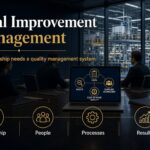
Total Improvement Management connects leadership, people, processes, and measurable results. A quality management system can organize that work. It cannot replace the executives who have to make it work.
That is the subject of this Quality Minute Insights Podcast. Host Jenny Quality talks with Rick Harrington Jr., founder and CEO of Harrington Group International, about why leadership needs a quality management system, and why improvement that stays inside the quality department does not last.
A legacy of improvement, applied to today’s plant
Rick shares the influence of his business partner and mentor, Dr. H. James Harrington, a quality management leader, Six Sigma Grand Master, and author of more than 55 books on business improvement, quality management, and process improvement.
The conversation connects that legacy with the problems on the floor now: AI-assisted problem solving, supplier quality, the cost of poor quality, audit evidence, and leadership accountability.
Improvement is not a quality-department project
Total Improvement Management reaches beyond the quality department. Lasting improvement requires resources, ownership, and follow-through. A charter without a budget, an owner, and a check that the change held is a presentation, not a result.
Before closing the next improvement project, ask three questions:
- Did performance improve?
- Did the change hold?
- Can we show the evidence?
If the answer to any of those is no, the project is not finished.
Where people still own the work
AI can draft an 8D or speed a CAPA narrative. Human accountability still belongs on the report. Someone has to confirm the cause, approve the action, and check that the action worked and did not create a new problem. A generated draft is not evidence.
Supplier scorecards have the same limit. A score without an escalation rule and a required action is a chart. Poor delivery, recurring nonconformances, and unanswered SCARs need an owner and a consequence, not another dashboard tile.
Scrap, rework, and warranty are not quality-department statistics. They are business performance. The cost of poor quality is one of the clearest arguments a CEO, COO, or CFO has for funding the system that prevents the next loss.
Evidence still has to connect
For medical device manufacturers, FDA’s QMSR and ISO 13485 keep the audit-record discussion in front of leadership. An audit finding, a corrective action, a document revision, a calibration record, a supplier action, and a training record should not live as separate files.
HQMS helps organizations connect audits, corrective actions, document control, calibration, supplier actions, and training records. The system helps organize the evidence. Leadership sets priorities, funds the work, and holds the organization accountable for results.
Software supports the process. It does not cancel the standard, and it does not close the project.
Who this is for
This episode is for CEOs, COOs, CFOs, plant managers, quality managers, quality engineers, regulatory affairs professionals, and continuous improvement leaders.
The biggest barrier to lasting improvement is usually one of four things: resources, ownership, disconnected records, or follow-through. Name which one is stopping the work, then fund the fix.
Watch the episode: Total Improvement Management: Why Leadership Needs a Quality Management System
Explore HQMS at hgint.com, or call Harrington Group International at 800-ISO-900027